Bunbury
Ocean Pool
A free, saltwater, tidal pool in the old basalt quarry. Designed. Costed. Studied to death. Voted through unanimously. And still not built.
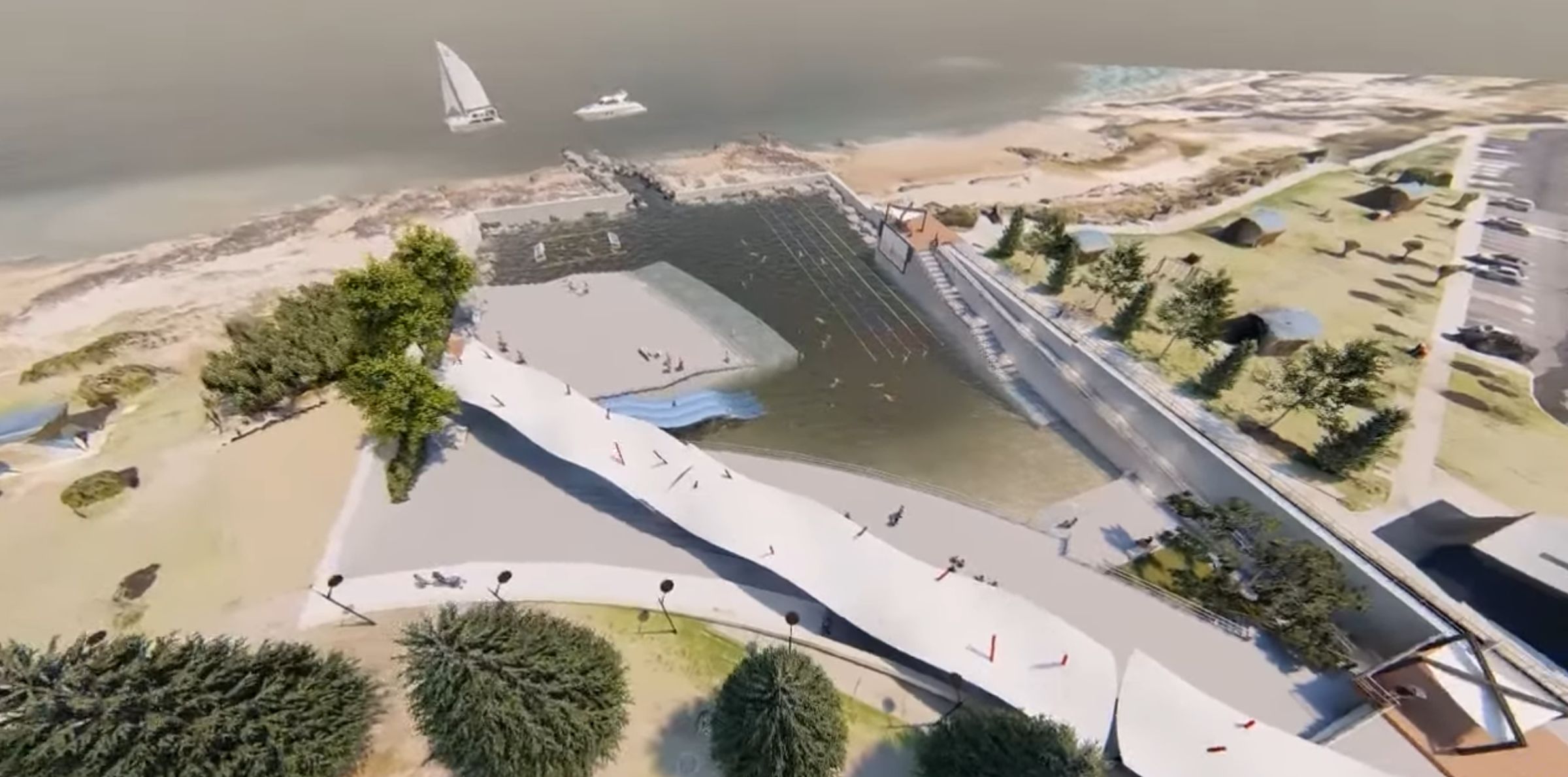
We didn’t do any of this work.
Other people in this town spent seven years getting it this far. The design exists. The studies exist. The council vote happened. There is nothing left to prove and nobody left to convince — which is exactly why it’s stuck.
Who actually did it
This started as somebody’s election platform and turned into a fully documented project.
Todd Brown campaigned on an ocean pool as a councillor in 2017, got knocked back for a scoping study in the budget, and went and ran the thing as a community campaign instead. BCE Surveying donated a ground-penetrating radar survey of the old quarry. Calibre Consulting produced the first concept designs and the video above. That campaign — Bunbury Beach Pool Concept — is what put this in front of council with something people could look at.
The City of Bunbury then did the unglamorous half. MP Rogers & Associates ran the fatal-flaw study. WML did the geotechnical work. GHD ran the environmental suite: pool flushing and coastal water quality, benthic habitats, flora and vegetation, contamination, hydrogeology, noise, landscape and visual impact. Brad Goode & Associates ran the Aboriginal heritage survey. Bridge42 built the business case. Officer Woods Architects, with Nicole Larkin Design Architecture and Realm Studios, produced the refined concept design in June 2023.
None of that was us. We’re not claiming it and we’re not running it. This page exists for one reason: everything that can be done by doing work has been done, and the only thing left is political will.
What it is
A saltwater pool set into the basalt scar the quarry left behind.
Four zones. A 50-metre lap pool with four lanes. A 25-metre, two-lane rehabilitation pool at a constant depth, for people recovering from injury, learning, or walking laps. A children’s pool with a live basalt bottom, zero to 600mm deep. And a 1:20 entry ramp wide enough for a wheelchair — or a bobcat, when the sand needs clearing out.
No chlorine and no chemical dosing. Seawater is drawn in through a pipe under the sea bed and flows straight back out, replacing the whole pool roughly every three and a half hours. In winter it overtops in storms, which is the point of building it in the intertidal zone rather than beside it.
Free to enter. No gate, no ticket, no opening hours. Alongside it: a shade canopy, changerooms, a kiosk and a community room, staged so they can be built as money allows rather than all at once.
Why it matters
Bunbury is a coastal city where a lot of people can’t safely use the coast.
Back Beach is exposed. Swell, rips and the westerly mean that for older swimmers, nervous swimmers, kids learning, and anyone rehabbing a knee, the ocean is effectively shut. An ocean pool is the thing that opens it — that is precisely what they were built for everywhere else they exist. The rehabilitation pool is the part nobody puts on a postcard and the part that quietly matters most.
The second argument is economic, and it usually gets made badly. This would be the first ocean pool built in Australia in about sixty years, and the only one in Western Australia. Not the nicest — the only one. Bunbury currently gives a driver on the Forrest Highway no reason at all to turn off, and the entire South West tourism economy is built on people deciding to turn off.
The third is the simplest. Free, permanent, unbookable, no membership. There are not many places left that belong to everyone by default, and we do not build them by accident.
And it has been owed for a while. The 1890s council took control of Wyalup Rocky Point to stop illegal basalt mining and floated an ocean bath. In 1907 they started quarrying with the explicit goal of carving one out — 82 metres by 18, three metres deep. The Depression stopped it. The quarry closed in the late 1940s, became a swimming hole and a campground through the fifties, filled with sand, and by the early sixties nobody could swim there any more. The hole is still in the rock.
Where it’s at
Every stage that can be completed by doing work has been completed. What’s left is a funded line in somebody’s budget, and that isn’t a technical problem.
- 1890s – 1960s
Started, abandoned, buried
State Engineers pick the end of Symmons Street. Quarrying begins in 1907 to carve out the pool. The Depression stops it, the quarry closes in the late 1940s, and by the early sixties the hole has filled with sand.
- 2017 – 2019
A local picks it back up
Todd Brown runs on it, loses the budget request, and runs a community campaign instead. BCE Surveying scans the old quarry, Calibre Consulting draws it, and about 30,000 people watch the video.
- Feb 2021
No fatal flaws
MP Rogers & Associates deliver the feasibility and fatal-flaw study. The finding: buildable. Council endorses it in August, with $250,000 committed by the State and $50,000 from the City for further work.
- 2022 – 2023
Everything gets tested
Geotechnical investigation, ground radar, contamination sampling, benthic habitat, pool flushing and coastal water quality, flora, noise, visual impact, Aboriginal heritage survey, and a full business case.
- June 2023
Designed, costed, voted through
Officer Woods Architects, Nicole Larkin Design Architecture and Realm Studios deliver the refined concept. A packed council meeting endorses the business case and concept plan unanimously. Price tag: $17.82 million.
- Aug – Sep 2023
The town gets asked
A community survey runs for a month and two information sessions are held with the architects. Well attended, robust discussion.
- Oct 2024
Council backs continuing
Council notes the project update and supports continuing feasibility work and funding investigations. The mayor names the 2025 state and federal elections as the moment to chase money.
- Now
Waiting on money We are here
No construction funding is committed by anyone. Nothing is being built, and nothing will be until a state or federal budget carries a line for it. This is the stage where projects quietly die of nothing in particular.
- Next
Schematic design and approvals
Take the concept to schematic design, secure consent under section 18 of the Aboriginal Heritage Act, clear the environmental and coastal approvals, then procure.
- After
Construction
Roughly eighteen to twenty-four months on site, working around winter weather windows.
The money, plainly
We’re going to put the awkward numbers on the page ourselves.
Capital cost is $17.82 million excluding GST. The City’s own share in the business case is $5.94 million — about a third — with the rest expected from the State, the Commonwealth, or private investment. That is the gap, and that is the entire fight.
Running it is estimated at $385,000 a year. Over a twenty-year model, once renewal and eventual capital upgrades are provisioned, the City would need to set aside around $611,350 a year. Those figures are the City’s own, out of the endorsed business case. You will hear them used as an argument against the pool, and they are a legitimate thing to argue about.
What we’d say about them: that’s the recurring cost of a free, permanent, city-wide public asset, in a town that has never had one on this coast. Compare it to what gets spent on things that serve fewer people, and then decide. But decide on the real number, not on whichever number sounds worst in a comment thread.
What we’re
asking for
Three things, all of them specific, none of them requiring anyone to change their mind about anything.
1
A funded line, from the State
The City can’t carry two thirds of $17.82 million on its own and has never claimed it could. This needs a state or federal commitment to exist as a real number in a real budget.
2
Publish the 2023 survey
A month-long community survey closed in September 2023. Whatever it found, the town that answered it should get to see the result. If it’s already been published, tell us and we’ll link it here.
3
Keep it moving to schematic
Concept design isn’t buildable. Getting to schematic design and through the heritage and environmental approvals is what makes it shovel-ready the day money appears, instead of two years after.
0
People backing this project
Add your name to the number that gets handed to the people who sign the cheque. One email, one postcode, one click to confirm.
The total and the postcode split get published. Your email never does, and it never goes to a candidate, a party or a developer.
The case
against
Every objection here has actually been made, in public, by someone in this town. Pretending they don’t exist would be the fastest way to deserve losing.
We can’t get the potholes on our street done but there’s eighteen million for a swimming pool in the sea.Recurring — council submissions and local social media
Fair instinct, wrong ledger. Road maintenance comes out of the City’s operating budget, funded largely by rates. Two thirds of this project is meant to come from state and federal capital grants that exist for destination and recreation infrastructure and can’t be redirected to resurfacing.
Put plainly: if the ocean pool doesn’t get built, that money doesn’t turn up on your street. It goes to a project in another town that put its hand up. The City’s own $5.94 million share is the part that is genuinely competing with other local spending, and that’s the number worth arguing about.
Nobody ever talks about the operating cost. That’s the bit that lands on ratepayers forever.Raised at council — and it’s the sharpest objection on this list
People do talk about it, and the number is public: about $385,000 a year to operate, and roughly $611,350 a year once you provision for renewal across a twenty-year model. We’ve put both figures in the money section above rather than leaving them for someone else to reveal.
A tidal pool has no filtration plant, no heating and no chemical dosing — the recurring cost is cleaning, inspection, sand and seaweed removal, and periodic structural work. Materially cheaper than a conventional pool. Not free. The honest version of this argument is a trade-off, not a trick, and anyone telling you the running cost is trivial is overselling it.
Rocky Point is one of the last bits of that coast left alone. Concreting it is not an improvement.Coastal residents and environment submissions
Wyalup means ‘place of mourning’, named for graves in the area. There are two registered heritage places on and beside the site, and the ethnographic survey found the basalt outcrops carry a Dreaming story that runs along most of the west-facing coast here. Gnaala Karla Booja representatives have asked that cultural interpretation be built into the project. Section 18 consent under the Aboriginal Heritage Act is required before anything happens.
On the environmental side: the pool sits inside the scar the quarry already cut, which is the whole reason that location was chosen — it means less new excavation, not more. GHD have assessed benthic habitat, flushing and coastal water quality, vegetation and visual impact, and the outer pool wall is designed as a living seawall to propagate marine life rather than sterilise the edge.
The position here: no version of this proceeds without Traditional Owner agreement on siting, form and naming. The approvals stage exists to test the impact claim with evidence rather than vibes, and if it says the site can’t carry it, that’s a real answer and it goes on this page.
This is a solution looking for a problem. Just go for a swim.Common online response
The beach isn’t available to everyone on most days, which is the entire point. And the leisure centres are indoors, chlorinated, ticketed and have opening hours. The lap pool was deliberately cut back to four lanes in the business case precisely so it wouldn’t compete with them — this is not a second aquatic centre and was never designed as one.
Ask a seventy-year-old who swims every morning, or a parent teaching a five-year-old, or someone six weeks into a shoulder rehab, whether the existing options cover it. The answer comes quickly.
The Back Beach baths got smashed to bits and filled with sand. Why would this be any different?Raised every time the subject comes up
It’s the right thing to point at, and it’s why coastal engineers were the first consultants hired rather than the last. The design expects overtopping in winter storms and is built to shed it — perimeter wall at 3.50 AHD, water level at 3.20, scuppers and gravity drainage in the north-west corner, and sea level rise of 0.35 metres provisioned across fifty years.
Sand is the honest risk, not waves. The site fills with sand seasonally and always has. That’s why the entry ramp is 3.5 metres wide and rated for a skid-steer loader: the maintenance plan assumes machinery will drive in and clear it out, several times a year, forever. It’s a cost, and it’s in the $385,000.
Bunbury’s been talking about this since before I had kids. It’s a fantasy.Overheard constantly — and the most dangerous objection here
This is the one that actually kills projects. Not opposition — exhaustion. A town talks itself out of something by agreeing in advance that it’s impossible, and then the agreement makes itself true.
The facts as they stand: no fatal flaws, site chosen, geotech done, environmental studies done, heritage survey done, business case done, concept designed and costed, council vote unanimous. Every step except money has been taken. It has never been closer, and the only variable left is whether enough people are visibly behind it when the next budget gets written.
Go and
check
Everything above comes from the public record. Don’t take our word for any of it.
The City’s project page
Official status, history and the studies undertaken, straight from the City of Bunbury.
Community Connect
The consultation hub, the FAQ with the operating cost figures, and the document library holding the concept plan.
Bunbury Beach Pool Concept
The community campaign that got this off the ground in the first place. Still the best place to follow it.
The concept video
The 2019 flythrough that made it feel real to about thirty thousand people.
Next one, you’ll know first
0on the list
The pool isn’t the last of these. Get on the list and you’ll hear when the next project goes live — once, with a link, and nothing else.
Email and postcode. Nothing else, ever.
One email per project. No newsletter. Leave whenever.